
Robot cables rarely fail the way people expect. They do not usually wear through from the outside or get cut by something. They fail from the inside, from motion the cable was never specified to take, and the first symptom is almost never a clean break.
The five causes worth knowing
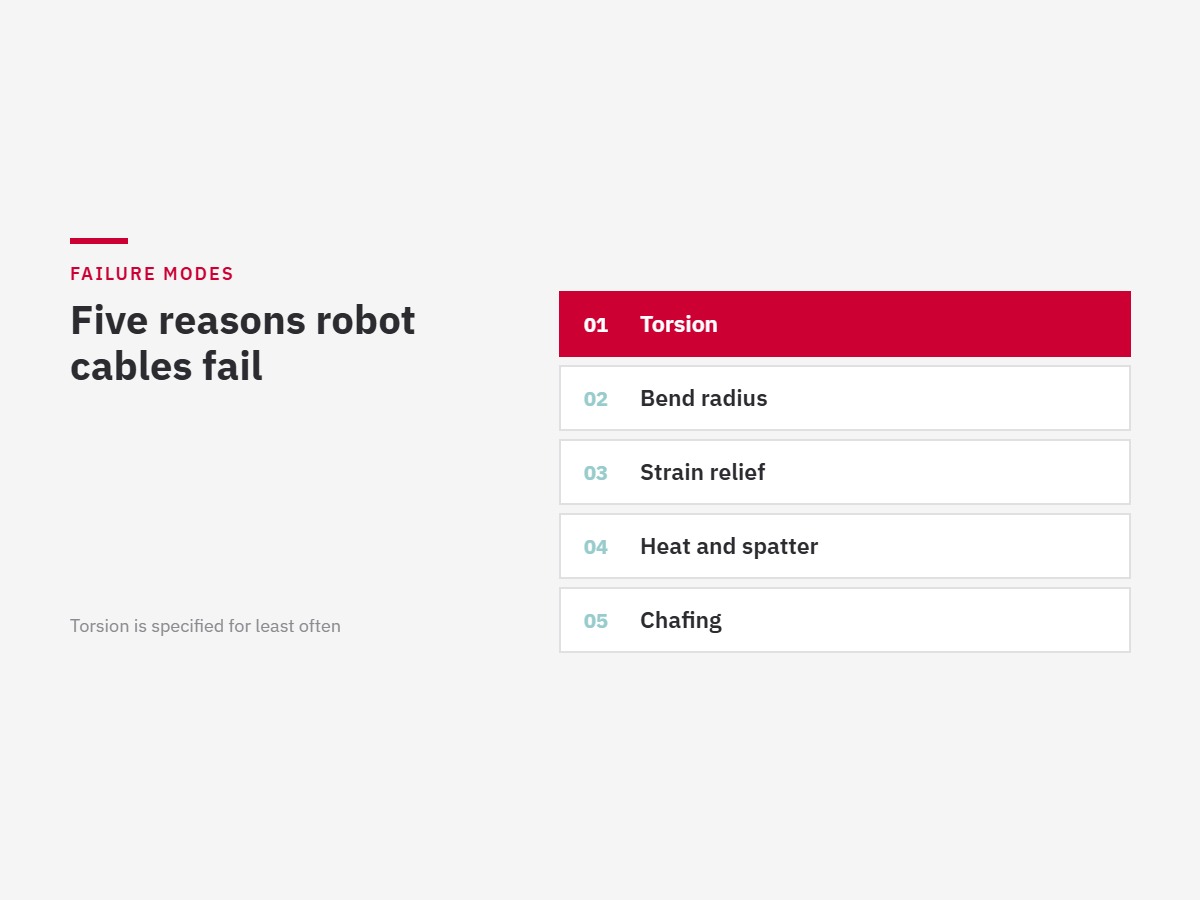
1. Torsion, not bending
This is the big one. A robot wrist rotates; it does not simply bend. A conductor rated for millions of bend cycles can fail within months under repeated twisting, because torsion works the strands against each other along the whole length rather than at one point. Cables intended for robot use are specified separately for torsion — Becker’s motion cables are rated to ±180° per metre, some to ±360° — and a cable without a torsion rating is a cable that has not been tested for the thing most likely to kill it.
2. Bend radius violated somewhere in the path
A cable meets its rated life at or above its minimum bend radius. The rating is void at the one point in the cycle where the radius is tighter, and that point is often not visible at rest — it appears at full extension or at a specific wrist orientation. This is why routing is proven in simulation rather than eyeballed on the shop floor.
3. Strain relief that grips the bundle instead of the cores
If one clamping ring squeezes a whole bundle, the cores inside migrate slowly under motion. Over months they work their way against the clamp and break at the strain-relief point — always at the same place, which is the giveaway. Clamping rings sized per core diameter avoid this.
4. Heat and spatter
Jacket material ages faster than the conductor. Radiant heat hardens the jacket everywhere, so it cracks at the first tight radius; spatter destroys it at specific points. Both are protection problems rather than cable problems — see high-temperature and spatter environments.
5. Chafing against the robot or the fixture
A package that is not fixed at defined points will find something to rub against. This is the one failure mode that is obvious on inspection, which is why it tends to get blamed for failures actually caused by the four above.
What failure looks like before it stops the line
- Intermittent signal or feedback errors that clear on restart — usually a broken strand making contact part of the time
- Position or encoder faults that appear only at certain wrist orientations
- A slow rise in unexplained cycle faults with no other cause
- Fluid weeping at a fitting rather than an obvious leak
- Jacket that has gone hard or discoloured at a specific point
Intermittent faults are the expensive ones because they get chased through the controller and the robot before anyone looks at the cable.
Preventing it
- Specify for torsion, not just bending, on every axis that rotates
- Prove the routing in simulation before building, including full extension
- Clamp each core at its own diameter
- Protect where heat and spatter actually land, with replaceable consumables
- Inspect on a schedule and record what you find — see the maintenance checklist
Related reading
What is a dress pack · Routing rules · Service life · The cost of cable-related downtime · Replacement and retrofit