
The honest answer is that it depends on the duty, and anyone who gives you a number without asking about the application is guessing. What we can do is tell you what actually determines it, so you can judge whether your own packs are lasting as long as they should.
What determines service life
Cycles, not months
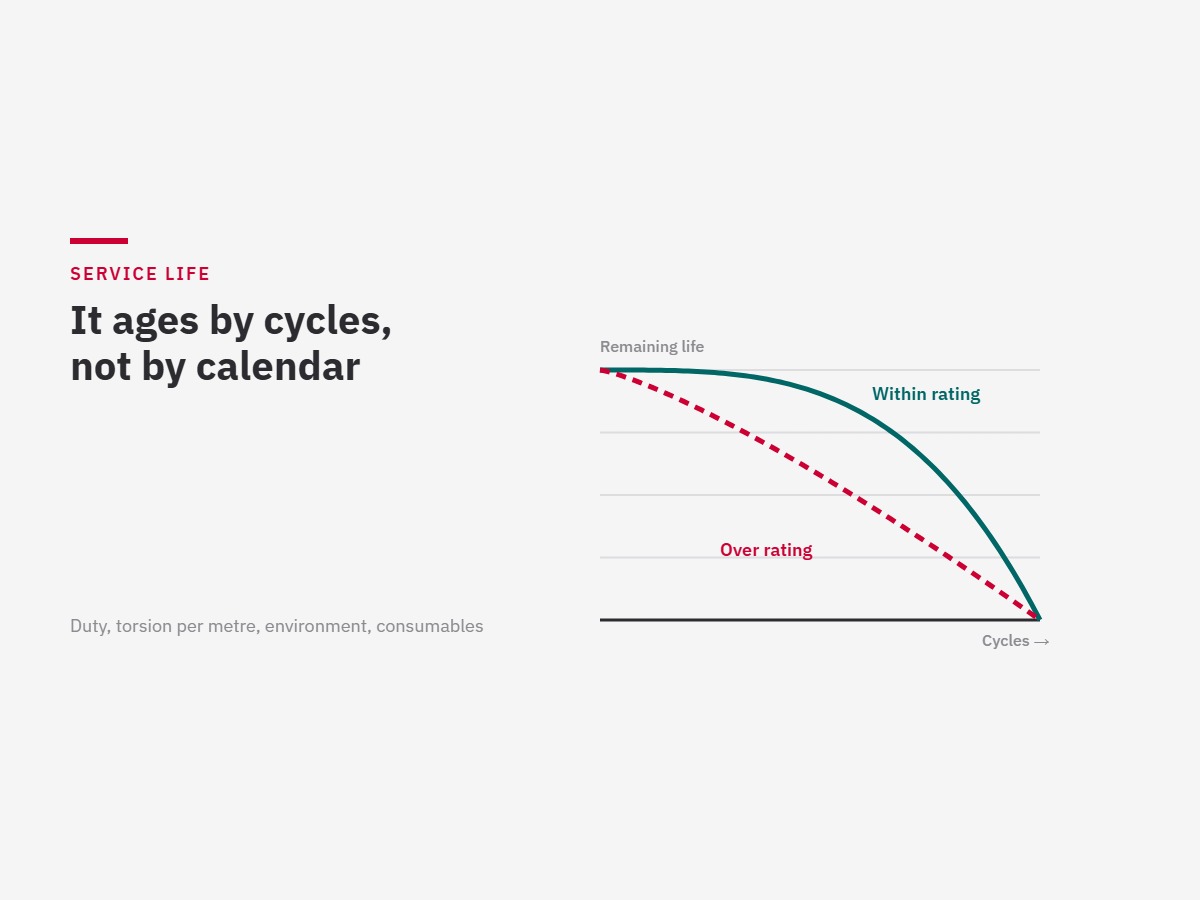
A dress pack ages by motion, not by calendar. Two identical packs, one on a three-shift line and one on a development cell, will not reach the same point at the same time. Cable ratings are quoted in cycles for the same reason — five million bend cycles at a stated radius, one million torsion cycles at a stated angle per metre.
Torsion per metre in the actual installation
The single biggest variable. A cable rated for ±180° per metre installed with a shorter free length is being asked for more than its rating on every cycle, and its life falls sharply rather than gradually. See routing rules.
Environment
Heat ages the jacket everywhere at once; spatter destroys it at points; coolant and cleaning chemicals attack it selectively. A pack in a hot weld cell and the same pack in an assembly cell are not the same product in service-life terms.
Whether the consumables are treated as consumables
Protection sleeves, corrugated tube and tube protectors are designed to be replaced. If they are left until they fail, the cable package underneath takes the damage and the whole pack is scrapped early. This is the most common reason a pack falls short of its potential life, and the cheapest to fix.
How to tell where yours is
- Jacket that has gone hard, chalky or discoloured at a specific point — heat ageing, localised
- Flattening or witness marks at a clamp — core migration, usually a strain-relief problem
- Intermittent faults that clear on restart — a conductor partly broken and making contact some of the time
- Corrugated tube worn through on one side — a chafe point that will reach the cable next
- Fluid weeping at a fitting rather than an obvious leak
The intermittent electrical faults matter most. They are the ones that get chased through the controller for weeks before anyone inspects the pack.
Getting the full life out of a pack
- Specify for the torsion the installation actually imposes, not the catalogue average
- Replace protection sleeves and tube on a schedule rather than on failure
- Record inspections so that a trend is visible — one worn clamp is an observation, the same clamp three times is a design problem
- Keep the spares that match your packs, so a scheduled replacement is not an order lead time
When replacement is the right call
A pack with a broken conductor can sometimes be repaired, but a pack showing jacket ageing along its length is telling you the whole package has reached the end of its environment-limited life — and repairing one core buys weeks, not years. Where the pack is being replaced anyway, that is the moment to review whether the routing that killed it should change.
Related reading
Why robot cables fail · Maintenance checklist · The cost of cable-related downtime · Spare parts · Replacement and retrofit · What a dress pack costs
Send us photographs of a worn pack and we will tell you what it is showing.