
Cable failure is the leading cause of unexpected downtime on robotic production lines, and it is consistently under-costed — because the invoice that gets remembered is the price of the replacement part, not the hours the line stood still.
Work out your own number
We are not going to quote an industry figure at you; the number that matters is yours, and it is not hard to assemble:
- Units per hour that the line produces when running
- Contribution per unit — margin, not revenue
- Hours lost per incident, from the fault occurring to the line running at rate again
- Incidents per year attributable to cable or hose failure
- Add the labour on the recovery, and any scrap or rework caused by the stop
Multiply it out. In most automotive body shops the answer surprises people, because the third line — hours per incident — is much larger than the maintenance team’s own estimate of it.
Why the hours per incident are larger than they feel
A cable fault is rarely diagnosed immediately. The characteristic failure is intermittent: a conductor partly broken, making contact some of the time. That gets chased through the controller, the tool and the robot first, sometimes over days of stop-start production, before anyone inspects the pack. Then the replacement has to be found, and if the right pack is not in stores, the clock keeps running.
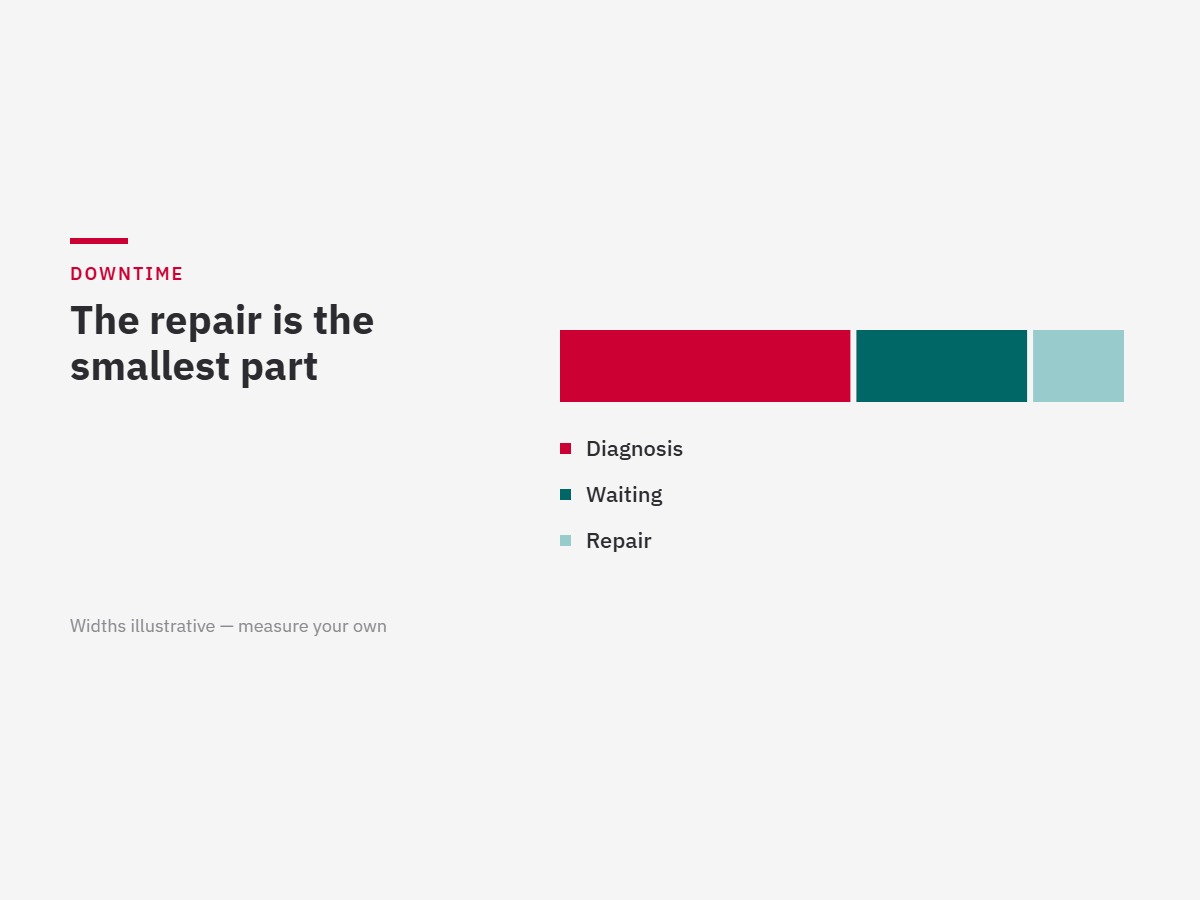
So the real cost of a cable failure is diagnosis time plus waiting time plus repair time — and the repair is usually the smallest of the three.
The three levers
1. Make failures less frequent
Correct specification for torsion, routing proven in simulation, per-core strain relief, and protection treated as consumable. See why robot cables fail.
2. Make diagnosis faster
Documentation attached to the specific robot rather than filed somewhere — drawings, I/O lists, spares schedule and maintenance history — removes the search from the critical path. That is what DCDI is for.
3. Make the replacement faster
This is where dress pack architecture earns its place. The LHMS is a closed, sealed package developed with FANUC, with no robot-specific adjustment at fitting, and a documented mean time to repair of seven minutes or less for material handling and fifteen minutes or less for carried spot welding. Against a conventional pack change, that is the difference between a stop absorbed by a break and a stop that costs a shift. See LHMS.
Where to start if you only do one thing
Record the cable- and hose-attributable stoppages for a quarter, with honest start and end times. Most plants discover the frequency is roughly what they expected and the duration is double. That single measurement usually justifies the specification work on its own.
Related reading
Why robot cables fail · Service life · Condition monitoring and DCDI · What a dress pack costs