
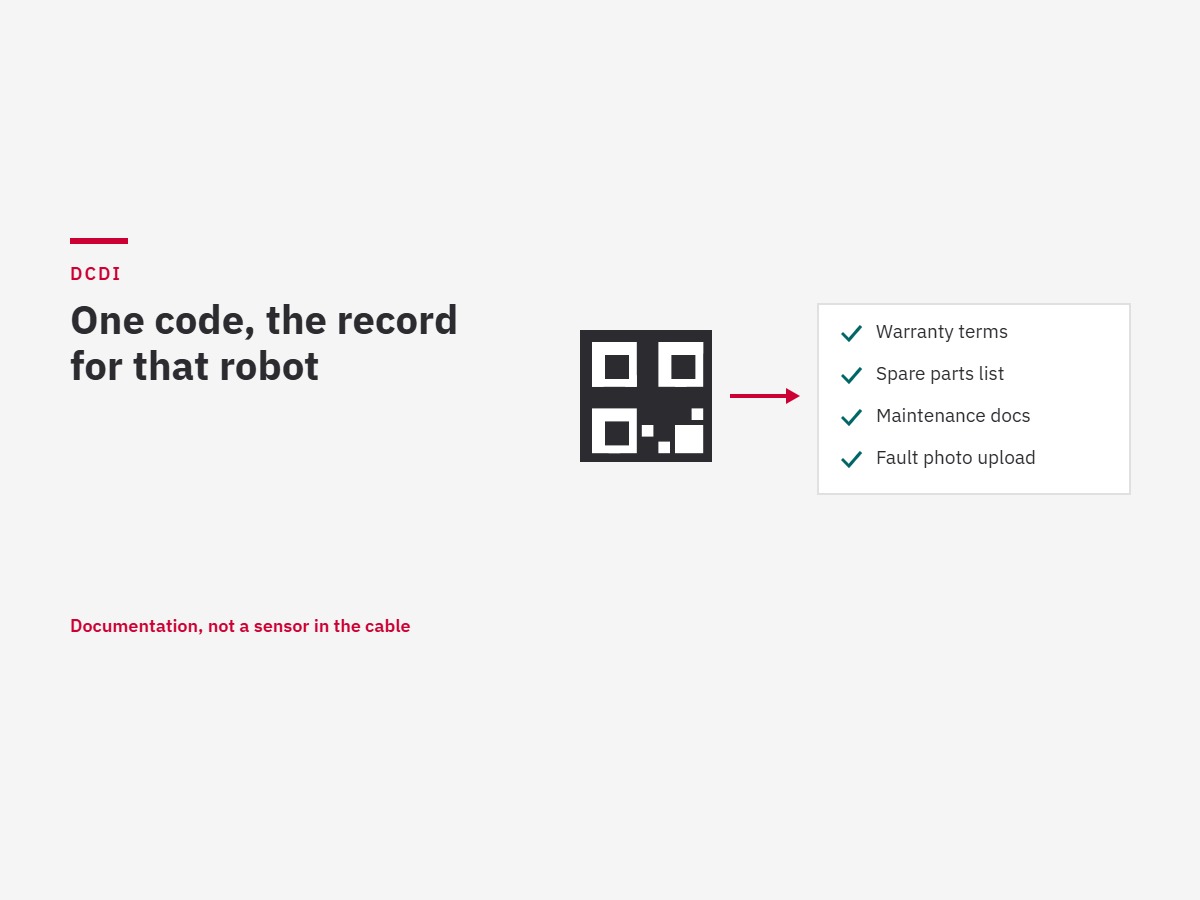
When a dress pack needs attention, the delay is usually not the repair. It is finding out what is fitted, which spares it takes, what the warranty position is, and who to call. DCDI removes that search by attaching the answers to the robot itself.
What it is
DCDI — Digital Customer Database Interface — is a QR code on each robot system. Scanning it opens the record for that specific installation:
- The Becker account manager for the system, with contact details
- Warranty terms for that installation
- The final check document from build
- The spare parts list for the pack actually fitted
- Installation manual and maintenance documentation
- A photo upload, so a technician can send us what they are looking at rather than describe it
Why per-robot matters
A plant with a hundred robots does not have one dress pack specification; it has dozens, accumulated over years of line changes. A generic manual tells a technician what a pack of that family needs. A per-robot record tells them what this one needs — which is the difference between ordering the right clamping ring and ordering three and hoping.
It also survives staff turnover. The person who knew which pack was on which cell eventually leaves; the QR code does not.
Condition monitoring in practice
Becker provides scan-activity statistics per robot back to the customer. That is a genuinely useful maintenance signal: a robot that is being scanned repeatedly is a robot someone keeps going to look at, and repeat attention is usually the earliest visible sign of a developing problem — before it becomes a stoppage.
We should be precise about what this is and is not. DCDI is documentation and attention tracking, not a sensor in the cable. It does not measure strand breakage or predict remaining life electronically. It tells you where your maintenance effort is actually going, which for most plants is information they do not currently have at all.
Fitting it into existing maintenance
The inspection routine does not change — see the maintenance checklist. What changes is where the findings go: against the robot, in a record that the next person will find, rather than into a folder or a memory.
Access
Access is controlled per customer, so the documentation for your installations is visible to your people and not to anyone who scans a code on a plant tour.
Related reading
The cost of cable-related downtime · Maintenance checklist · Service life · Spare parts