
Some robot faults are controller problems, some are mechanical, and a surprising number are cable or media problems wearing a disguise. This is a guide to telling them apart, written from the dress pack side — because that is the side most often eliminated last.
It applies to any brand. The symptoms below behave the same on FANUC, ABB, KUKA, Yaskawa and Kawasaki robots, because they come from the physics of a moving cable rather than from a controller.
Intermittent signal, encoder or feedback faults
Looks like: an error that clears on restart and comes back hours or days later, sometimes only at certain positions.
Usually is: a partly broken conductor making contact some of the time. Position-dependence is the tell — if the fault appears at a particular wrist orientation and not others, the cable is being loaded in that position.
Check: run the robot slowly through the full programme and watch for the fault against arm position. Inspect at clamps and at the entry to the tool.
Faults that appear only at full extension
Usually is: a bend radius violated at the far end of the envelope, or a package too short for the reach. Neither is visible at the home position, which is where people look.
Repeat failures at the same physical point
Usually is: a strain-relief problem, not a cable problem. If one clamping ring grips a whole bundle, the cores migrate and break at that clamp — and the replacement will do exactly the same thing. Replacing the cable without changing the clamping is how a plant ends up buying the same pack every year.
Loss of air, coolant or process media
Check first: fittings rather than hose. A weep at a fitting is far more common than a hose failure, and much easier to miss than an obvious leak.
Jacket hardened, chalky or discoloured
Usually is: heat ageing, and it is telling you about the environment rather than the cable. See high-temperature and spatter environments.
Corrugated tube worn through on one side
Usually is: a chafe point — the package is touching something it should not through part of the cycle. The tube did its job; find the contact before the next one wears through.
What to eliminate before blaming the robot
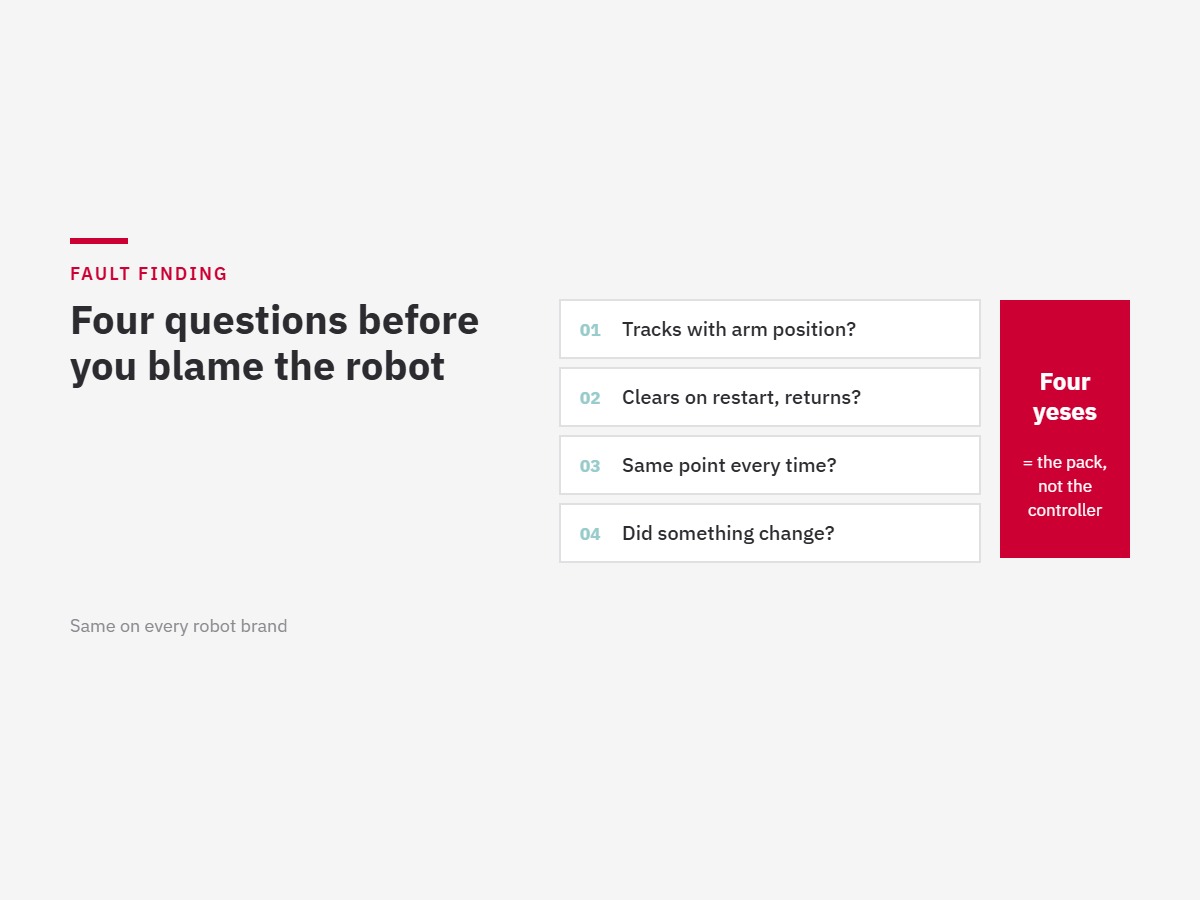
- Does the fault correlate with arm position?
- Does it clear on restart and return?
- Is it always the same physical location on the pack?
- Did anything change recently — a new tool, a re-taught path, a moved fixture?
- When was the protection last replaced?
Four yeses point at the dress pack, not the controller.
Related reading
Why robot cables fail · Maintenance checklist · Routing rules · Replacement and retrofit
For faults in the robot itself, the manufacturer’s own documentation is the right source. If you want a second opinion on whether a fault is cable-related, send us the symptom and a photograph.